Based on Your Knowledge of Energy Conservation
Carbon acts as an energy currency in ecosystems because light is converted to organic carbon compounds (sugars, fats, proteins), and organic carbon compounds are then converted to chemical energy. Hence, the total amount of organic material that is produced by plants is directly related to the amount of light energy that is absorbed. This is primary production, a term that refers to the growth of plants or change in their total biomass. It is referred to as 'primary' production because it is biomass that is produced directly from CO2, whereas secondary production is produced from already existing organic material. Primary production is expressed in terms of carbon fixed per unit time and per unit space, and represents a fundamental property of an ecosystem, which is the rate of energy generated over time.
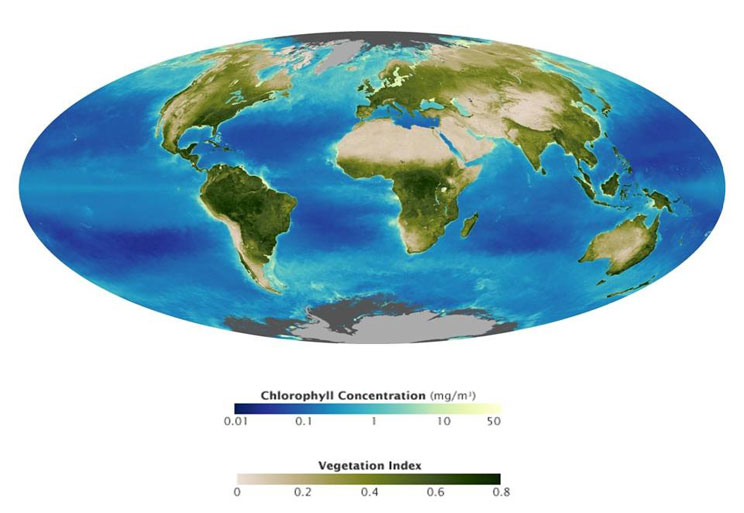
Figure 1: NASA satellite image of the global biosphere in 2008
Green shading on land shows the normalized difference vegetation index (NDVI), which is strongly correlated with plant primary production. Blue shading in the oceans depicts surface chlorophyll concentrations; chlorophyll concentrations are directly related to the abundance of microscopic marine plants, or phytoplankton, and can be used to quantify marine primary production. (Courtesy of NASA Earth Observatory)
As one might imagine, measuring all plant growth in a forest or all phytoplankton growth in a sea is extremely challenging. However, because this is ultimately related to the amount of light energy that is absorbed, and we can measure absorbed and emitted light using satellites in space, scientists have figured out clever ways to measure primary production using satellite data. This works because ecosystems seem to have a relatively consistent light use efficiency (LUE) that represents the proportion of light absorbed that is converted to biomass. Interestingly, this is a small proportion of the total energy that reaches Earth from the sun — a lot of sunlight is reflected, or absorbed and re-radiated back to space — and if you look around and see how much plant growth or primary production occurs, you get an idea of how much energy the sun can provide. Satellite data have given us broad pictures of the living biosphere that can be used to determine the total amount of production, carbon, and energy that cycles through ecosystems (Figure 1).

Figure 2: The energy and carbon economy of an ecosystem
Plants performing photosynthesis convert carbon dioxide to organic carbon compounds using sunlight as a source of energy; these compounds go on to fuel nearly all other organisms in the ecosystem, from bacteria to animals. Arrows depict the fluxes of carbon and energy between different ecosystem components.
Using maps like these, we can compare different places, or measure primary production from season to season or year to year. When this was first achieved by Field et al. in 1998, scientists were surprised to find that about the same amount of total primary production occurs in the ocean as on land, despite different physical dynamics that select for different primary producers (marine phytoplankton and land plants). The oceans cover a much larger area than the land, so per area rates are lower than they are on land. As one might expect, different regions have very different levels of production, with tropical forests being extremely productive and deserts and polar tundra being much less productive. The oceans also show strong variation from the mid-ocean gyres — which are essentially marine deserts — to the productive tropical and polar oceans.
How primary production, energy, and carbon are subsequently used varies even more widely from ecosystem to ecosystem. Much of it is consumed by herbivores, but some of it falls to the ground or to the deep ocean bottom; some of what herbivores eat becomes biomass, but much is respired, and some becomes waste. These relative proportions vary spatially and temporally, but eventually, carbon produced by plants is used by the diversity of organisms present in a given ecosystem. Even 'waste' products are a rich source of energy and other nutrients for microorganisms such as bacteria and fungi, and so waste is consumed over time. Some carbon remains resistant to attack, or 'recalcitrant,' (for example, many organic compounds in soil are recalcitrant), but most fixed carbon can be used as a source of energy, and is then returned to the atmosphere as CO2. All these carbon fluxes are often partitioned into an alphabet soup of gross primary production (GPP), net primary production (NPP), plant respiration (Rplant), heterotroph respiration (Rheterotroph), net ecosystem production (NEP), and net ecosystem exchange (NEE); these are concepts that are explored in ecosystem ecology and exhibit remarkable patterns. For example, NPP, plant respiration, and heterotroph respiration all seem to be approximately equal across many ecosystems (Figure 2).
But what happens if this carbon budget becomes unbalanced? What would happen over time, for example, if heterotrophic respiration were a little less than NPP? The result is ecosystems such as peatlands, where organic material builds up in the soils. When those peatlands are drained and used in other ways (e.g. as oil palm plantations in southeast Asia), that carbon ends up back in the atmosphere. There are other important and interesting exceptions to the rule of carbon balance, and as humans continue to produce energy and food, we continue to alter the carbon balance of ecosystems.
Based on Your Knowledge of Energy Conservation
Source: https://www.nature.com/scitable/knowledge/library/energy-economics-in-ecosystems-13254442/
0 Response to "Based on Your Knowledge of Energy Conservation"
Post a Comment